
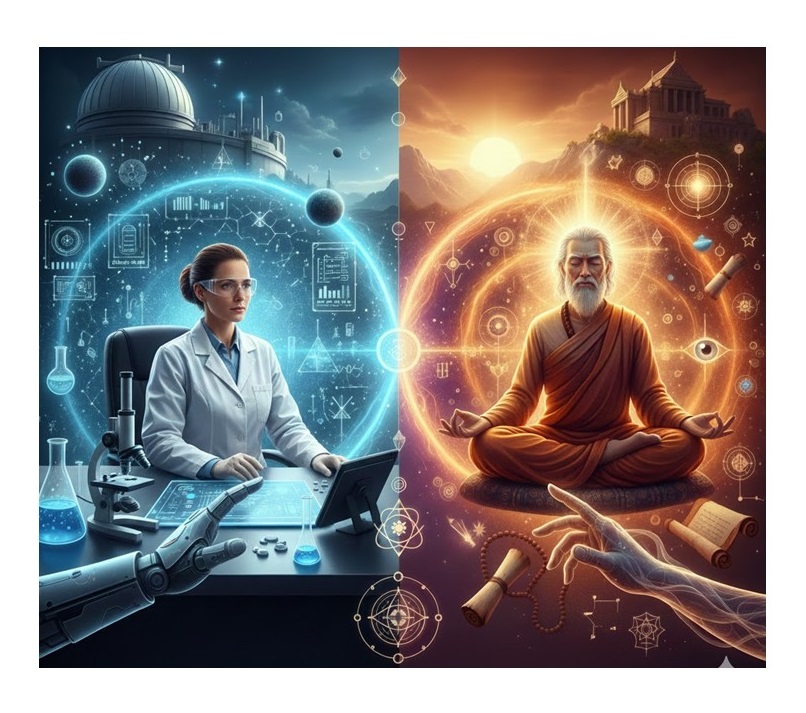
Walk through any modern city and the signs of progress are unmistakable; smartphones in every hand, hospitals equipped with cutting-edge technology, satellites circling the Earth, and instant access to information. By every measurable indicator, science has improved human life. However, beneath this surface of achievement lies a quieter, unsettling reality: rising mental distress, fractured communities, environmental exhaustion, and growing unease about how technology is shaping human behavior. This contradiction forces society to confront an uncomfortable truth progress without purpose is incomplete.
In contemporary public discourse, science & spirituality are often portrayed as opposites. One is said to rest on reason and evidence, the other on belief and introspection. This divide, however, is neither natural nor necessary. From an Indian civilizational perspective, it is deeply misleading. Science & spirituality are not rivals but they are complementary dimensions of knowledge. Its integration is not philosophical luxury it is a social necessity. Science answers the question of how. How to cure disease, how to grow more food, how to travel faster, how to process information. These achievements have increased life expectancy, reduced poverty, and connected the world at an unprecedented scale. Advances in medicine, engineering, agriculture, renewable energy, space science, and digital technology stand as testimony to the power of systematic inquiry. But science, by its very nature, is value-neutral. It does not tell us why we pursue certain goals, nor whether every technological possibility should be exercised. This is where spirituality becomes indispensable not as blind belief, but as disciplined inquiry into values, consciousness, and responsibility. That is why, in the Indian tradition, spirituality has never meant withdrawal from life. It is profoundly practical. Concepts such as dharma (ethical duty), ahimsa (non-violence), lokasaṅgraha (welfare of all), and santosha (contentment) act as invisible regulators of society. They restrain excess, temper ambition, and align personal success with collective well-being. Without such an ethical compass, scientific power can turn destructive; a lesson history has taught repeatedly, from environmental devastation to weapons capable of annihilation. India’s intellectual heritage offers a striking contrast to the modern tendency to separate knowledge into silos. Ancient Indian epistemology recognized multiple valid means of knowing: empirical observation (pratyakṣa), rational inference (anumāna), and direct experiential insight (anubhava). Ayurveda combined observation with a holistic understanding of body and mind. Yoga systematically explored attention, cognition, and emotional regulation long before neuroscience began mapping neural pathways insights now validated by studies on stress reduction and mental health. Astronomy, mathematics, and metallurgy flourished within a culture that viewed knowledge not as domination over nature, but as a path to harmony.
These ancient ideas are not relics; they find expression in contemporary spiritual voices as well. Teachers like Shri Premanand Ji Maharaj translate timeless wisdom into language relevant to modern life. His emphasis on simplicity, inner discipline, humility, and service addresses a central paradox of our time: despite abundance, dissatisfaction grows. He points out that suffering often arises not from scarcity, but from an uncontrolled mind and endless craving. Behavioral science echoes this diagnosis, identifying desire amplification, constant comparison, and fragmented attention as root causes of modern stress. Premanand Maharaj’s stress on bhakti devotion and gratitude is not escapism. It is a method of mental stabilization. When individuals anchor themselves in higher purpose, anxiety and aggression diminish. A society composed of such individuals naturally governs better, consumes more responsibly, and uses technology with restraint. In this sense, spirituality functions as preventive social medicine, complementing scientific solutions that often intervene only after damage is done. The Indian worldview also offers clarity amid today’s environmental crisis. Nature is not treated as inert matter but as an interconnected system governed by ṛta, cosmic order. Reverence for rivers, forests, animals, and the five elements (pañcamahābhūta) internalized ecological responsibility. Modern environmental science now reaches similar conclusions through systems theory and climate models. The difference is that spirituality transforms sustainability from an imposed rule into a moral instinct.
Shri Premanand Ji Maharaj
Critics rightly warn against superstition masquerading as spirituality. That danger exists when spirituality loses its spirit of inquiry. But true spirituality, like true science, demands discipline, questioning, and self-correction. The answer is not to dilute science with belief, nor to reject rationality in favor of faith, but to cultivate a scientific temper guided by ethical wisdom. India’s great thinkers from Swami Vivekananda and Sri Aurobindo to C.V. Raman and A.P.J. Abdul Kalam consistently argued for this synthesis. Message of these great leaders remains urgent. A blissful and healthy society cannot be built on economic growth alone. Physical health requires mental resilience, social trust, ethical governance, and ecological balance. Science provides capability; spirituality provides direction. Together, they offer not just progress, but progress worth sustaining.
By Santosh K. Tiwari, PhD
No comments yet. Be the first to comment!

Rechargeable batteries are essential to modern society, quietly enabling...
View now
Quantum computers represent one of the most profound shifts in the histo...
View now
Graphene: The Strongest Material Ever Discovered...
View now